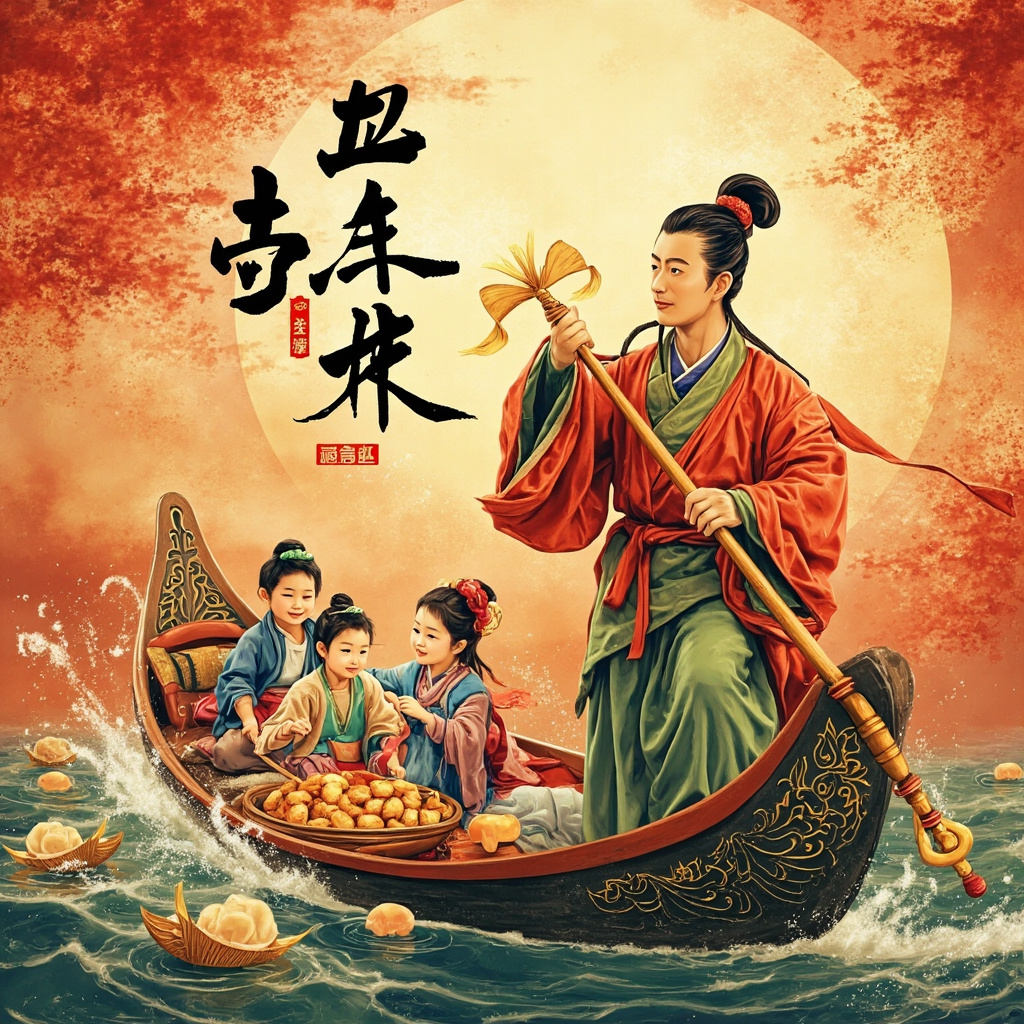
The Dragon Boat Festival, known in Mandarin as the Duanwu Festival (端午节), is a major traditional holiday celebrated in China and across East Asia
What is the Dragon Boat Festival (Duanwu)?
The Dragon Boat Festival, known in Mandarin as the Duanwu Festival (端午节), is a major traditional holiday celebrated in China and across East Asia. It falls on the fifth day of the fifth month of the Chinese lunisolar calendar and is marked by dragon boat races, sticky rice dumplings (zongzi), and rituals to ward off evil.
Also called the Double Fifth Festival, this event is a significant public holiday in mainland China, Hong Kong, Macau, and Taiwan, and is observed by Chinese communities worldwide. While most popularly associated with the legend of the poet Qu Yuan, the festival's roots are even more ancient.
When looking at Chinese holidays explained through a historical lens, the festival's timing near the summer solstice is critical. In ancient beliefs, the fifth lunar month was considered an unlucky and dangerous period. The summer heat and humidity were thought to bring disease and awaken venomous creatures. Consequently, many Dragon Boat Festival traditions were originally developed to dispel evil spirits and prevent illness.
Our analysis of historical texts within our cultural context database confirms that the festival's earliest practices were focused on health and purification. Activities like hanging mugwort and calamus on doors, wearing scented sachets, and (historically) drinking realgar wine were all intended to protect people during this volatile seasonal transition.
When is the Dragon Boat Festival Celebrated?
The Dragon Boat Festival is always celebrated on the 5th day of the 5th month of the traditional Chinese lunar calendar. Because the lunar calendar is based on the moon's cycles, this fixed "double fifth" date corresponds to a different date on the Gregorian (solar) calendar each year, typically falling in late May or June.
The key to understanding the festival's timing lies with the lunar calendar. This ancient system tracks time based on the phases of the moon, resulting in a year that is about 11 days shorter than the solar year we use for daily scheduling. This discrepancy is why the Dragon Boat Festival date appears to shift annually from a Western perspective.
A common mistake we observe is people marking a specific solar date on their calendar for the following year, only to realize later that the festival has already passed or is yet to come. The essential rule to remember is that "the fifth day of the fifth month" refers strictly to the lunar calendar. To provide clarity, our cultural context database cross-references the traditional lunar calendar with the Gregorian calendar to give you the precise date for any given year. Therefore, while the festival's spirit is constant, its date on our everyday calendars is a moving target that follows the ancient rhythm of the moon.
The Legend of Qu Yuan: Origin of the Festival
The Dragon Boat Festival's most enduring origin story centers on Qu Yuan, a poet and minister of the Chu state during China's Warring States period (c. 475–221 BCE). His tragic protest against state corruption and subsequent death in the Miluo River directly inspired the festival's key traditions of dragon boat racing and eating zongzi.
Qu Yuan was a fiercely patriotic and trusted advisor who advocated for strengthening the Chu state to resist the growing threat of the powerful Qin state. However, his counsel was rejected, and he was slandered by corrupt officials, leading to his exile. During this time, he wrote some of China's most acclaimed poetry, expressing his despair and unwavering love for his homeland. Historical accounts document that upon learning that the Qin army had captured the Chu capital, Qu Yuan was overcome with grief. On the fifth day of the fifth lunar month in 278 BCE, he clasped a large stone and drowned himself in the Miluo River as a final act of protest.
The local villagers, who greatly admired the poet, rushed out in their boats to try and save him or at least recover his body. This frantic search is said to be the origin of dragon boat racing. They beat drums and splashed their paddles on the water to scare away evil spirits and prevent fish from devouring his body. When they could not find him, they began throwing balls of sticky rice into the river to feed the fish, hoping this would keep them from Qu Yuan's remains. This act evolved into the tradition of making and eating zongzi.
The Qu Yuan story provides a powerful narrative that ties the festival's main activities directly to an act of historical loyalty and sacrifice. The diagram below illustrates how these traditions emerged from the events of the legend.
While this account is the most popular explanation for the Dragon Boat Festival history, it's important to note that other origin theories exist, some linking the festival to ancient agricultural or health-related rituals. We explore these alternative perspectives in greater detail within our cultural context database.
Dragon Boat Racing: Symbolism and Sport
Dragon boat racing is a vibrant, competitive water sport central to the festival, symbolizing the legendary search for the poet Qu Yuan. The races feature long, narrow boats decorated as dragons, propelled by synchronized paddlers who move to the beat of a drum, embodying community spirit and cultural heritage.
The most popular legend ties the origin of dragon boat races to the desperate attempt by villagers to save the poet Qu Yuan from drowning in the Miluo River in 278 BCE. The frantic paddling and drum-beating were meant to scare away evil spirits and fish from his body. However, the tradition likely predates this story, with roots in ancient rituals to appease river deities. As our cultural context database clarifies, Chinese dragon symbolism portrays dragons as powerful, benevolent water spirits who control rain and rivers. The boats are carved and painted to resemble these dragons, a gesture to honor them and ensure a prosperous year.
A modern dragon boat team is a perfect example of synergy. It typically includes up to 20 paddlers, a drummer at the bow, and a steersperson at the stern. The paddlers must stroke in perfect unison, a feat achieved by following the rhythmic beat of the drum. The drummer is considered the "heartbeat" of the boat, setting the pace and morale, while the steersperson guides the vessel. This intense synchronization highlights the cultural values of teamwork, discipline, and collective effort.
What began as a folk ritual has evolved into a highly competitive international sport. While traditional races remain a key part of festival celebrations across Asia, dragon boat racing was formalized in the 20th century. Today, federations govern competitions worldwide, with standardized boat specifications and rules. This global adoption has transformed the ancient tradition into a thrilling spectacle that unites people from diverse backgrounds in a shared celebration of strength, endurance, and teamwork.
Zongzi: The Iconic Festival Food
Zongzi are pyramid-shaped sticky rice dumplings wrapped in bamboo or reed leaves, serving as the quintessential food of the Dragon Boat Festival. These savory or sweet parcels are not just a seasonal delicacy; their cultural significance is deeply rooted in the legend of the poet Qu Yuan, symbolizing protection and remembrance.
At its core, a zongzi is a parcel of glutinous rice with various fillings, which is then steamed or boiled. The outer wrapping, typically bamboo or reed leaves, imparts a distinct, earthy aroma to the rice during the cooking process. Fillings vary dramatically by region, ranging from savory options like marinated pork belly, salted duck egg yolks, and mushrooms to sweet varieties filled with red bean paste or dates.
The profound zongzi meaning comes from its connection to the festival's origin story. According to records in our cultural context database, the tradition began when villagers threw packets of rice into the Miluo River to prevent fish and evil spirits from devouring the body of the drowned poet-official Qu Yuan. These sticky rice dumplings served as both an offering to his spirit and a way to protect his physical remains. Today, making and eating zongzi with family is a central activity that honors this ancient act of community and reverence.
Regional Variations: Sweet vs. Savory Zongzi
Zongzi, the iconic glutinous rice dumplings of the Dragon Boat Festival, are systematically classified by a distinct north-south culinary divide. Northern Chinese traditions favor sweet fillings like red bean paste and dates, treating zongzi as a dessert, while Southern Chinese cuisine champions complex, savory versions with ingredients like pork and egg yolk.
This fundamental split between sweet vs. savory zongzi is one of modern China's most passionately debated culinary topics. The distinction goes beyond mere preference, reflecting deep-seated regional traditions in ingredient availability and flavor profiles. When exploring our cultural context database, we often see users surprised that the types of zongzi extend far beyond this simple binary, revealing a rich tapestry of local tastes.
Northern Sweet Zongzi (甜粽 - tián zòng) In Northern China, zongzi are typically simpler and treated as a sweet snack or dessert. The glutinous rice is often left plain, serving as a neutral canvas for sweet fillings. The most classic fillings include sweet red bean paste and whole Chinese red dates (jujubes), which impart a mild, fruity sweetness. After being steamed or boiled, these zongzi are often served with a small dish of sugar or drizzled with honey for extra sweetness.
Southern Savory Zongzi (咸粽 - xián zòng) Conversely, Southern China is the heartland of savory zongzi, which are often substantial enough to be considered a full meal. Here, the glutinous rice itself is frequently seasoned with soy sauce, five-spice powder, and fried shallots before wrapping. The fillings are far more elaborate, featuring rich ingredients like soy-marinated pork belly that melts in your mouth, savory salted duck egg yolk, shiitake mushrooms, chestnuts, and sometimes dried shrimp.
To provide a clear comparison, we can systematically classify the core differences between these two dominant styles.
| Feature | Northern Style (Sweet) | Southern Style (Savory) |
|---|---|---|
| Primary Flavor Profile | Sweet, dessert-like | Savory, umami-rich, and complex |
| Common Fillings | Red dates (jujubes), red bean paste, millet, assorted grains | Marinated pork belly, salted egg yolk, mushrooms, chestnuts |
| Rice Preparation | Plain, unseasoned glutinous rice | Glutinous rice seasoned with soy sauce, oil, and spices |
| Typical Shape | Often long and conical or a smaller tetrahedron | Typically a larger, four-cornered pyramid or pillow shape |
| Consumption Style | Eaten as a snack or dessert, often dipped in sugar | Eaten as a complete, self-contained meal |
While the sweet-versus-savory debate dominates the conversation, it barely scratches the surface of regional diversity. Guangdong province is famous for its large Cantonese-style zongzi (廣東粽), packed with an abundance of luxury ingredients. Meanwhile, the Jiaxing zongzi (嘉兴粽) from Zhejiang is renowned for its perfectly tender pork, and some regions in Sichuan even create spicy zongzi with chili and Sichuan peppercorns.
Customs for Health and Protection
The Dragon Boat Festival's health customs are ancient practices designed to ward off disease and evil spirits during the summer's onset, a time historically associated with illness. These traditions, including hanging aromatic herbs and wearing protective sachets, functioned as a form of preventative public health before the advent of modern medicine.
A central theme of the festival is purification and protection. As we explore in our cultural context database, the fifth lunar month was traditionally considered a "poisonous" or unlucky period due to rising temperatures, humidity, and the proliferation of insects and bacteria. To counteract these threats, families engage in several key customs:
-
Hanging Mugwort and Calamus: On the day of the festival, bundles of mugwort and calamus are hung on the front doors of homes. These aromatic herbs release strong scents that are believed to repel insects, especially mosquitoes, and drive away evil spirits. The long, sword-like shape of calamus leaves is also thought to provide symbolic protection against malevolent forces.
-
Wearing Perfume Pouches (香囊, xiāng náng): Children, in particular, often wear colorful, embroidered silk perfume pouches filled with a mix of fragrant herbs and traditional Chinese medicinal powders. These sachets serve a dual purpose: their pleasant aroma acts as a personal air freshener and insect repellent, while the medicinal ingredients are believed to ward off illness and evil.
-
Drinking Realgar Wine (雄黃酒, xiónghuáng jiǔ): A once-common tradition was the consumption of realgar wine, an alcoholic beverage mixed with a small amount of an arsenic sulfide mineral. It was believed to expel toxins and protect against venomous creatures. However, it is critical to note that realgar is highly toxic and this practice is now extremely rare and strongly discouraged for health and safety reasons. In some modern, symbolic observances, a small amount of the wine might be dabbed on a child's forehead or ears rather than ingested, but even this is uncommon today.
The Five Poisonous Creatures
The “Five Poisonous Creatures” (五毒, wǔ dú) are a group of animals from Chinese folklore believed to be especially potent and dangerous during the fifth lunar month. This superstition identifies the snake, scorpion, centipede, toad, and spider (or sometimes a lizard) as harbingers of disease and misfortune.
Traditionally, the fifth month of the lunar calendar was considered an unlucky and dangerous time. Marking the start of summer, the rising heat and humidity created ideal conditions for venomous creatures and disease-carrying pests to multiply. This led to a higher risk of plagues and illnesses, solidifying the month's reputation as the "Poisonous Month" (毒月, dú yuè). To protect themselves, people developed specific rituals to ward off these negative influences.
The five creatures most commonly associated with this period are:
- Snake (蛇, shé)
- Scorpion (蝎, xiē)
- Centipede (蜈蚣, wúgōng)
- Toad (蟾蜍, chánchú)
- Spider (蜘蛛, zhīzhū) or Lizard (壁虎, bìhǔ)
To counteract their evil, people would create protective talismans featuring images of these five creatures. Based on the principle of "fighting poison with poison" (以毒攻毒, yǐ dú gōng dú), it was believed that displaying the images of these pests could repel them and the evil spirits they represented. These talismans took many forms, from intricate paper cutouts hung in windows to colorful embroidery on children's clothing, especially on items like scented sachets or "tiger-head shoes." Our cultural context database highlights that this practice is a fascinating example of how folk beliefs transformed sources of fear into symbols of protection.
Celebrating Duanwu Today
The modern Dragon Boat Festival is a vibrant holiday that blends ancient customs with contemporary energy, serving as a key time for family reunions centered on zongzi. While rooted in Chinese culture, its most iconic element—dragon boat racing—has evolved into a globally competitive sport, ensuring the preservation of this rich heritage.
Today, celebrating Duanwu is a multifaceted experience. For many, it remains a cherished occasion for family gatherings, where generations connect over the shared tradition of making and eating zongzi. At the same time, the athletic spectacle of dragon boat racing has transcended its origins, with international festivals and competitions drawing diverse teams and spectators in cities worldwide. This global appreciation transforms the event from a regional custom into a celebration of teamwork and cultural exchange. As we document in our cultural context database, this evolution is a powerful example of how ancient traditions adapt and find new meaning across different communities. Ultimately, the modern Dragon Boat Festival stands as a testament to the enduring power of cultural heritage, connecting the past with the present through food, family, and sport.
Q: Why do people eat Zongzi during the Dragon Boat Festival?
A: The tradition of eating zongzi, sticky rice dumplings wrapped in bamboo or reed leaves, is a way to commemorate the patriotic poet Qu Yuan. According to legend, after he drowned himself in the Miluo River, villagers threw rice into the water to prevent fish from eating his body, an act that evolved into this culinary custom.
This practice is rooted in the story of Qu Yuan, a respected minister and poet of the state of Chu during the Warring States period (475-221 BC). When his kingdom was conquered by the state of Qin, Qu Yuan, in a final act of patriotism and despair, drowned himself in the river on the fifth day of the fifth lunar month.
Local villagers, who admired him greatly, rushed out in their boats to try and save him or at least retrieve his body. When they couldn't find him, they dropped balls of sticky rice into the river, hoping the fish would eat the rice instead of the poet's body. An old doctor also poured realgar wine into the river to stun any underwater dragons.
Over time, this act of remembrance evolved. To ensure the rice reached Qu Yuan's spirit (and wasn't eaten by a river dragon), people began wrapping the rice in leaves and tying them with colorful silk threads. This is the origin of the zongzi we eat today, a symbolic food that honors Qu Yuan's sacrifice and is a central part of festival celebrations.
Q: Is the Dragon Boat Festival the same date every year?
A: The Dragon Boat Festival's date changes annually on the Gregorian (solar) calendar because it is based on the traditional Chinese lunisolar calendar. It consistently falls on the fifth day of the fifth lunar month, a date rich with historical and cultural significance tied to ancient agricultural cycles and celestial events.
This system ensures the festival aligns with the seasons as they were traditionally observed. While the Gregorian calendar is solar-based, the lunisolar calendar tracks time using the phases of the moon and the solar year. This causes the festival to land on a different date in May or June each year.
The festival's Chinese name, Duanwu Jie (端午节), directly translates to "Double Fifth Festival," highlighting its fixed lunar date. This timing was historically considered a dangerous and unlucky period at the start of summer, which is why many Dragon Boat Festival traditions, like hanging mugwort, focus on warding off evil spirits and disease.
To see how this works, here are the festival dates for the next few years:
- 2024: June 10
- 2025: May 31
- 2026: June 19
Q: What is the main purpose of the Dragon Boat Festival?
A: The Dragon Boat Festival primarily serves a dual purpose: to commemorate the patriotic poet Qu Yuan and to ward off evil spirits and disease at the beginning of summer. Key traditions like dragon boat racing and eating zongzi are directly linked to the legend of Qu Yuan's death.
The festival's two main objectives are:
-
Commemoration of Qu Yuan: The most popular origin story attributes the festival to honoring Qu Yuan, a minister and poet who lived during China's Warring States period. When he drowned himself in the Miluo River to protest corruption, local villagers raced out in boats to save him and threw rice into the water to prevent fish from eating his body. These acts evolved into the traditions of dragon boat racing and making zongzi.
-
Protection and Health: The festival falls on the fifth day of the fifth lunar month, traditionally considered an unlucky and "poisonous" time when insects and pests emerged. Therefore, many customs are aimed at dispelling evil and preventing illness. These include hanging mugwort and calamus on doors, drinking realgar wine (a practice now rare due to its toxicity), and wearing scented sachets filled with protective herbs.
Q: What are the 'Five Poisons' associated with the festival?
A: ### What are the 'Five Poisons' associated with the festival?
The 'Five Poisons' (五毒, wǔ dú) refer to five venomous or troublesome creatures believed to be most active and malevolent during the fifth lunar month. These typically include the snake, scorpion, centipede, toad, and spider, and traditions like hanging herbs and wearing talismans are meant to ward them off.
Historically, the fifth lunar month, when the Dragon Boat Festival occurs, was considered a "poisonous" or unlucky time. The rising heat and humidity led to the spread of disease and the proliferation of pests. The 'Five Poisons' became a symbol for these seasonal dangers and the evil spirits thought to accompany them. While the list can vary by region (sometimes including a lizard or gecko), the concept remains the same.
To counteract these negative forces, several protective traditions are practiced:
- Hanging Mugwort and Calamus: Bunches of these aromatic herbs are hung on doors to repel insects and purify the air.
- Wearing Scented Sachets: Children often wear colorful, embroidered sachets (香包, xiāng bāo) filled with fragrant herbs and spices for protection.
- 'Five Poisons' Imagery: In some areas, images of the five creatures are made into paper cutouts or embroidered onto clothing. Often, a tiger (a symbol of power) is shown overcoming them to neutralize their threat.
- Drinking Realgar Wine: Historically, people drank realgar wine (雄黃酒, xiónghuángjiǔ) and dabbed it on children's foreheads. However, as realgar is an arsenic compound and toxic, this practice is now rare and strongly discouraged.
Explore Chinese Culture
Discover practical guides, cultural insights, and tips for celebrating Chinese festivals with confidence and respect.
Start Learning →Recent Posts
Check out our latest articles
Engaging in simple Chinese festival small talk is a powerful way to show respect and build a genuine cultural connection.
In Chinese business culture, holidays are not just breaks from work; they are critical opportunities to strengthen professional connections.
Chinese birthday traditions are deeply rooted in the concept of longevity and respect for elders,
The Chinese Ghost Festival, also known as the Hungry Ghost Festival, is a traditional holiday rooted in ancestor worship
The Mid-Autumn Festival is a traditional harvest celebration that falls on the 15th day of the 8th month of the lunar calendar.
The Lantern Festival, known as Yuanxiao Jie (元宵节), is a vibrant Chinese festival celebrated on the 15th day of the first lunar month